8 POSITIONS 2026
ANNE GEENE
annegeene.nl lives and works in Den Haag, Netherland.
Anne Geene's artistic work involves searching for forms, collecting and categorizing nature; she looks for anomalies, works with connections and invents new species. Her medium is photographic printing processes such as the cyanotype. On an art-historical level, she deals with concepts such as possession, completeness, selection and desire and searches for references to the present.
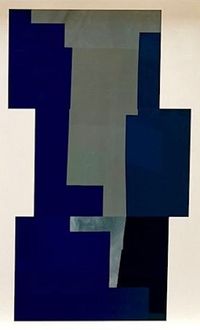
‘The Sea is the World’, 2026, accidental collage made by Google earth, Part of a series called ‘Bestiary’, a modern version of the middle age Christian handcoloured books about animals, water, plants and stones.
ASTRID STRICKER
lives and works in Berlin, Germany.
In her figurative pencil drawings, Astrid Stricker explores physical and psychological states through the dialogue between body and space.
Clear outlines define the exterior and interior or open up into the indeterminacy of space. In the same way, in her three-dimensional, model-like works, she develops frames and structures that dissolve the sculptural volume and reach into the space. The line is the connecting element between her drawings and her
sculptures.
R5-Cross-Swimmer, a bundle of vertical and horizontal rods forming a statically unstable construction, is part of the further developed series of frame works, which differ from earlier structure-like and model-like works in that they evolve into a more formally rigorous form.
Stricker uses a visibly integrated video projector to project herself as a swimmer onto the vertical rods and their crossbars.
Her works reveal both her engagement with informal sculpture and an opening toward an ironic take on the classical concept of sculpture. In the sculpture R3-Sirene, at the end of a slightly curved and unbalanced rod, there is a funnel-shaped construction—a sort of flower or loudspeaker—that emerges from the rod and reaches outward.
Her current sculptural objects consist of aluminum rods wrapped in fabric, which are then solidified with acrylic. This “simple set of tools” is a central concept in the artistic practice of Astrid Stricker. It enables open and direct working without aiming for perfection.
R5-Cross-Swimming / Detail | 2026 | ca. 82 x 35 x 35 cm | Alu, Fabric, Acrylic
CAROLINE KRABBE
https://carolinekrabbe.gallery
lives and works in Frigiliana / Spain.
Combining ceramics and drawing as a form of storytelling. Thoughts are communicated with the malleable material. The process requires concentration, patience and trust. It is a very mental approach. After many years of modular drawing on large paper, the figures now emerge from the drawings and meet the viewer as objects made of fired clay.
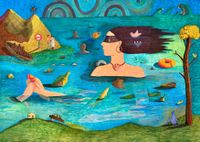
The Fluid Space, 2026, 70 x 100 cm, ink, oil pastel, colored pencil and watercolor, pen felt drawing on paper
CONCHA GALEA
lives and works in Mijas Costa / Spain.
The landscape and the female position. Woman as the "main figure of the work with autonomy, with identity"; of solitude and her perception of what is happening inside her and passing through her.

I chose the hippocampus because, to me, it represents a paradigm shift in nature. 2026
DeDe HANDON
lives and works in Frankfurt /M, Germany.
In her new work, *Living In The Plastisphere* 2026, DeDe Handon explores the profound changes occurring in marine habitats in the Anthropocene era. The works are based on the scientific finding that complex new communities have formed on plastic waste in the world’s oceans: microorganisms, bacteria, fungi, algae, and other organisms colonize the artificial surfaces of the waste and create a new, human-induced ecological sphere—the so-called “plastosphere.”
What at first appears to be a symbol of global environmental destruction also reveals a
perplexing paradox: even on the remnants of human civilization,
new life begins to emerge. What at first appears to be a symbol of global environmental destruction also reveals a
perplexing paradox: even amidst the remnants of human civilization,
new life begins to emerge. Plastic is no longer seen merely as a dead
material, but as a medium, a surface, and a habitat for biological processes.
It is precisely this ambivalence between destruction and transformation that lies at the heart
of my artistic exploration.
For her collages, she researches photographs of plastic waste from oceans,
coastal regions, and beaches. The images are printed on delicate Japanese paper
and partially processed on the reverse side, so that the fragments of
plastic shimmer only faintly through the material. The
visible traces appear like sedimented memories of a nature
reshaped by humans—ghostly relics of a global consumer society.
From these visual fragments, DeDe Handon develops new hybrid organisms and speculative
life forms. Using ink, lacquer, and watercolor, the collages coalesce into
complex networks reminiscent of cellular structures, microscopic specimens, membranes,
or unknown deep-sea creatures. The works deliberately navigate
the space between scientific imagery and poetic imagination. They appear like artifacts from a future underwater world or like cartographic records of a new evolution.
In other works, she condenses the imagery of the plastosphere into biomorphic reflections and translucent studies of organisms. On delicate Japanese paper, fragile forms emerge that oscillate between scientific illustration, microscopic
observation, and speculative marine fauna. The works appear like specimens of a future evolution—fragile life forms emerging from the remnants of human civilization.
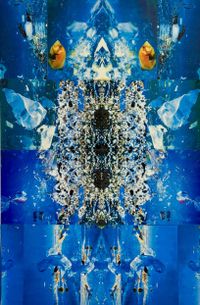
Morphieoitnane 1* Living In The Plastisphere, 2026, papercollage/ink, 97 x 107 cm
JUTTA HEUN
lives and works in Frankfurt /M Germany and Malaga / Spain.
"When will titmice be able to live in Greenland?" is a question about the rate at which the Greenland ice sheet is melting. For several years now, Jutta Heun has been studying the effects of climate change on ice and snow landscapes.
Titmice cannot currently live in Greenland because the environmental conditions there are extremely hostile. Titmice are adapted to temperate climates. In the harsh Arctic climate, the birds currently find neither habitat nor food. So far, titmice have only lived in forested. areas. The largest portion of the image is taken up by the depiction of the octopus, which references a photographic diptych by Jeff Wall. In 1990, he worked on the series “Still Life.” Jutta Heun first saw his 1990 work “An Octopus and Some Beans” at an exhibition at the MMK in Frankfurt, Germany. Jeff Wall described his photographs as “narrative images.” Like in a slaughterhouse or a Spanish market hall, the octopus lies alone on the brown wooden table.
Octopuses are highly imaginative, intelligent animals, with three hearts and multiple brains. With her depiction, Jutta Heun sought to counter the cold, matter-of-fact content of Jeff Wall’s work.
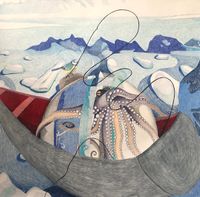
When Will Titmice Live on Greenland?, 2026, 150x150 cm, crayon on paper
ROBERTA LOZZI
lives and works in Milan, Italy.
The works of artist Roberta Lozzi are defined by four dimensions. ( written by Graziella Battaglino )
The first is space: the geometric arrangement of light fields projects an emotion or memory outward, stripping it of its personal origin and leaving it open to each viewer’s own interpretation. The second is color: over the lines of the drawing, color overlaps, fills them and erases them. The flat colors, which allow no gradations, and the essential forms, which leave no room for details, create a psychological suspension, a channel open to the involvement of the observer, who is free to interpret and to feel. The third is affective memory: light reveals an emotional world — dreamlike or remembered — suggesting a quiet, melancholic solitude. The human figures, often faceless in recent works, convey a shared, collective feeling. The fourth is absence: a sense of nostalgia and emptiness, a longing for a metaphysical dimension that seems lost in the modern world, leaving behind only the feeling of something missing.
“Border”, 2026, 21x29,7cm, mixed media on paper
SABINA HUBER
lives and works in Rincón de la Victoria, Spain.
As part of the group exhibition “OCHOessential” (Holbæk, Denmark, Summer 2026), artist Sabina Huber presents “La red invisible,” a series of sculptures that serves as a physical and transcontinental cartography of global waste. The main concept of the work is based on the use of “materials with memory” collected on the Andalusian coast and on the island of Zanzibar in the Indian Ocean. Huber collects these elements not merely as waste, but as objects that bear the traces of time and an invisible human imprint on nature, and uses them to create vessels and organic forms that denounce the planet’s oversaturation with plastic waste. With this project, the artist builds a conceptual bridge between two damaged geographical realities: the Mediterranean Sea off the Andalusian coast and the Indian Ocean off the coast of Zanzibar. Each work, named after places and local enclaves in the African island, strips the seascape of its tourist idyll to reveal its most critical and essential condition: the biological suffocation of the habitats that sustain human life. The series confronts the viewer with a profound material duality: ceramics—noble, durable, organic, and of terrestrial origin—stand in direct contrast to plastic—synthetic, destructive, toxic, and ubiquitous. On a formal level, the ceramic works meticulously replicate delicate marine structures, such as cephalopod tentacles, suction cups, fish scales, and seashells. The clear sheen of their glazed surfaces dramatically highlights the dirty, frayed, and chaotic texture of the recycled plastic fibers. The fishing lines, ropes, and industrial packaging in bright colors (yellow, blue, orange). They break through the organic color palette of the clay and create an immediate visual tension. By constricting and strangling the organic material simulated in the studio, these tension lines transform the ceramic textures into actual physical traps. Sabina Huber’s work thus becomes an indispensable warning about the vulnerability of living things and shows an international audience that plastic pollution has a single, destructive, and devastating global nature.
.jpeg/picture-200?_=19e2cc07d28)
PEMBA, La red invisible 1, 2026, gebrannter Ton, Pastikschnur